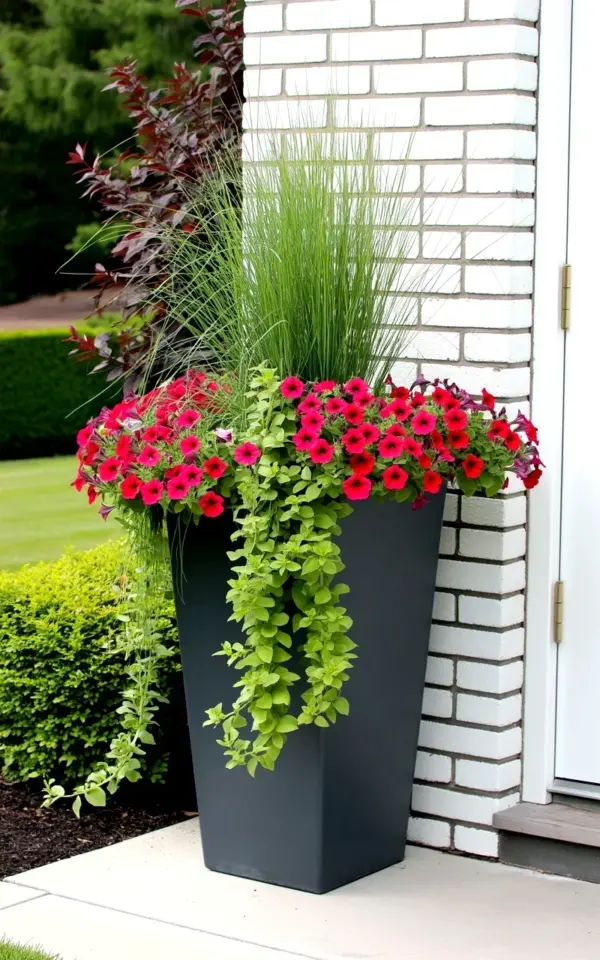
Honestly, I’ve walked past this exact setup a dozen times and I still stop to stare. There’s just something about that tall black pot, the red petunias spilling over the rim like they’re trying to escape, and the ornamental grasses shooting straight up. It’s one of those summer planter ideas that looks expensive, but it’s actually incredibly simple to recreate. And against that white brick wall? The contrast is unreal. The red pops so hard it practically glows, and the grass gives the whole thing a modern, structured vibe instead of just looking like a blob of flowers.
This combo is my current obsession for sunny entryways, and I think it deserves a spot on your porch too.
## Why This Black Pot and Red Petunia Combo Works So Well
Look, the container matters way more than people think, and here’s the thing: a black rectangular planter is a bold choice. Most garden centers are stocked with terracotta and cream glazed pots, but black just hits different. It disappears into the background and makes the red petunias the absolute star. I’m not gonna lie, I used to shy away from dark pots because I worried they’d soak up too much heat. And yeah, they do get warm. But if you’re planting sun-loving annuals like petunias, they honestly don’t mind the extra warmth at the root zone.
The white brick wall behind the planter is doing a lot of heavy lifting too. White acts like a reflector, bouncing light right back onto the flowers. It makes the red petunias look deeper, richer, almost velvety. I tried a similar arrangement against a dark gray fence once, and it just didn’t have that same fire. Don’t underestimate your background wall. If you have a lighter surface, use it. If you don’t, maybe paint a single section of fence or lean a large white board behind your pots. It feels a little extra, but the payoff is huge.
And let’s talk about that trailing green foliage. The petunias in the photo are cascading down the sides of the black pot, softening the hard edges of the rectangular container. Red petunias with that spill habit turn a basic planter arrangement into something that feels lush and full even when the grasses are still growing in. You need that overflow. It creates a bridge between the container and everything around it.
## The Best Ornamental Grasses to Pair with Red Petunias
Now, the grasses. That vertical element is the difference between a porch arrangement that’s pretty and one that makes people stop and snap photos. The tall green grasses in the photo reach up like little green fountains, and they balance out the trailing petunias perfectly. You want a grass that’s spiky, not flopping over. Think about grasses that grow in tight clumps and maintain their structure.
Here are a few options I personally like for this exact look:
– **Purple Fountain Grass**: This one is technically tender, but the burgundy color is gorgeous with red petunias. It won’t be exactly like the green grass in the photo, but the contrast is killer.
– **Carex or Sedge**: I’m a big fan of Carex for containers. It’s not a true grass, but it looks like one and it handles moist soil really well. The green spiky blades match the vibe of the photo perfectly.
– **Feather Reed Grass**: This is more upright and narrow, and it tolerates heat well, though it can get a little floppy in rich soil.
– **Sedge and Fiber Optic Grass**: For a lighter, airier texture, this one is a great pick. It grows to about 12 inches and has tiny white tips that shimmer.
Just don’t pick something that gets six feet wide. Containers are all about restraint. You need a grass that will stay in proportion with the pot and not swallow the petunias whole. The piece in the photo is definitely a green grass, maybe a medium-height feather grass or a sedge, and it’s planted right in the middle to anchor the whole thing.
## How to Arrange the Container Garden for Maximum Impact
Ok so the actual planting order in the photo is pretty specific. The tall black pot has the ornamental grasses in the center, acting like that high point, and then the red petunias circle around the base. This is the classic thriller, filler, spiller method. Honestly, it’s a formula that works every single time.
Here’s how I do it, step by step:
1. Start with the grass first. We’re talking thriller. Position it slightly off-center or right in the middle, depending on your pot. The spiky vertical line sets the tallest point of the arrangement.
2. Fill the rest of the space with petunias. One plant won’t be enough. For a rectangle like the one in the photo, I’d use at least 4 or 5 well-developed red petunia plants.
3. Let the petunias spill. Tuck them fairly close to the edge so their natural trailing habit can cascade down the black sides over the next few weeks.
4. Water deeply right after planting, and then check the soil daily for the first week.
Just pop the plants out of their nursery pots, loosen the roots if they’re bound, and get them in nice potting mix. It’s honestly a lazy Sunday kind of project, and it rewards you within a month.
## How Petunias and Ornamental Grasses Care Differently, and How to Fix It
Here’s the thing that trips people up, though. Petunias are thirsty and hungry, they want food constantly to keep blooming. Grasses are more like the low-maintenance friend who just wants some water and an occasional toast. You’d think you’d have to choose one or the other.
You don’t. The trick is to add a slow-release fertilizer to the soil mix at planting time, something like Osmocote Plus. And then, once a month, give everything a light dose of liquid plant food when you water. Red petunias are heavy feeders. If they want to spill over the sides of that tall black pot, they need energy to do it. If you skip the fertilizer, the grass will still look fine, but your petunia blooms will slow down and turn green, pale, and sad.
Sunlight is honestly the bigger issue for this particular container duo. Both love full sun, six hours minimum. If you put this in the shade, the grasses will get leggy and flop. The petunias will produce more leaves than flowers, and you’ll wonder if you accidentally bought a leafy green plant instead. Keep it on that sunny porch or entryway, just like the photo shows, and you’re already winning.
## Watering and Maintaining Your Red Petunia Summer Planter
The black pot in the photo is tall, and that’s actually a double-edged sword. Larger pots hold more soil, so they don’t dry out as fast as small ones. But because the pot is exposed to sun and wind, you still have to check it every day during a heatwave.
A really good trick is to stick your finger into the soil up to your second knuckle. If it feels dry, water it. If it’s damp, let it go. Petunias do not like being soggy, but they also completely freak out if they dry out. I’ve lost too many cascading red petunias to afternoon wilting, and they sometimes don’t bounce back if you wait too long. The soil in a black pot heats up fast, so during the hottest months of the summer, water in the morning. This gives the roots time to absorb before the heat hits, and it prevents the water from just evaporating instantly.
Deadheading is something you can do, but honestly? With trailing petunias, it’s not as critical as you read online. The newer varieties are self-cleaning, so the old flowers just drop off on their own. I still run my hands through the plants every few days to break off the spent blooms. It helps, but don’t kill yourself over it. The main thing is fertilization and water.
## Styling Ideas for Front Porch Decor with Black Planters
Let’s be real for a second, the actual beauty of this summer planter ideas concept is how the black pot elevates the front porch decor. A tall black rectangular pot is basically a minimalist statement. It’s a blank slate. If your porch is a little boring, dropping one of these in the corner changes everything.
Pair the black pot with lighter accessories. A cream doormat, a wooden bench, some galvanized metal watering cans, or even a set of pale stone pavers under the pot. The white brick wall already does this in the photo, but you’re bringing that same trick home. Dark and light together just scratch an itch in my brain. The red petunias add warmth and that classic summer garden feeling, while the tall green ornamental grasses keep the whole thing feeling fresh and modern rather than cottagey or old-fashioned.
Here’s a little extra detail, I like to add a layer of gravel or small rocks on top of the soil in my black pots. It stops the soil from splashing onto the petunias when you water, and honestly, it makes the whole planter look more polished, almost like a professional instalation. (I still don’t know why it looks better with rocks, it just does. Trust me on this one.)
If you want to make this look even more intentional, use two of the same black pots. Duplicate the setup and place them on either side of your front door. The symmetry is gorgeous and formal, and the red petunias will create a friendly, inviting path. It might feel like a lot of commitment, but you can scale the whole design down to a smaller spiky grass and only two petunia plants if you have a tiny porch or a balcony.
## What Else Can You Pair in a Tall Black Pot?
Maybe you want to recreate the photo exactly, or maybe you just want to use these components but change the color scheme. Here’s the good news, the black pot and grass structure works however you play with it.
– Try **white petunias** for a clean, breezy summer look that feels softer than the red version.
– Go with **yellow calibrachoa** for a bright, happy contrast. Those little blooming million bells spill just as nicely as petunias.
– Swap in **purple petunias** if you want a richer, moodier vibe. The dark pot and green grass will make the purple look almost magical at dusk.
– For the spiller, **sweet potato vine** in a dark copper color is amazing. It grows crazy long and fills the sides of the pot with zero effort.
Keep the tall green ornamental grass the same. It gives you that architectural height that anchors everything. If you use the same pot shape and the same grass, changing only the trailing plant can completely refresh your front porch from season to season. And when fall arrives, you can swap the petunias for ornamental peppers or kale and get a whole new look. The grass probably won’t survive a hard frost, so treat it as an annual and replant each summer.
## A Quick Planting Timeline for the Best Results
Let’s say you want to nail this look for the July heat. Start the project in late spring after the last frost. The exact timing depends on your growing zone, but mother’s day weekend is a pretty safe target for most of the country.
When you first plant, the arrangement might look a little sparse. The grasses will be short, maybe just a foot tall, and the petunias will be small. That’s totally normal. In the first month, the roots are getting established. By week three, you’ll see the petunias start to stretch out. By the time full summer rolls around, the pot will look like it does in the photo. The grass will have doubled in height, and the red petunias will be spilling all the way down the black sides.
Anyway, the takeaway here is pretty simple. You don’t need twenty different flower varieties to make a statement. You just need a sharp pot, a pop of red, and a strong vertical line. The white wall is a bonus. If you don’t have one, any plain backdrop can still work, you just want something that doesn’t compete with the flowers.
I’d love to know what you’re planting this season. Are you a red petunia person, or would you swap in a different spill? Save this one for planting season, and let’s make every porch in the neighborhood look this sharp. 🌸
Leave a Comment